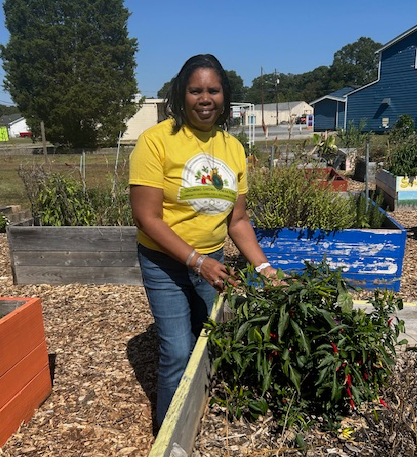
Soil toil wasn’t Cathy Walker’s groove. “I was a materialistic person,” she said.
Then she got a job with University of Georgia cooperative extension. Walker recalls, as she got started, returning to the office with her trainer.
“She would be all dirty. That wasn’t me. My boss would say, ‘So, Ms. Walker, where have you been?’ I learned how to garden without getting dirty. I put on gloves,” she said.
That was nearly 30 years ago. She kept at the work, focused on developing gardens at schools, parks, senior centers, and public housing projects around Atlanta. When the grant supporting her job expired, she took over direction of her extension agent boss’s 5-acre farm. She joined the American Community Gardening Association, where she is now going into her fourth year as president.
“Gardening really changed my life. You start to build relationships,“ she said. “You’re growing food, but you’re also growing a neighborhood. You’re dealing with the issues going on in your neighborhood.”
Keeping a community garden going isn’t easy, especially if the garden is the result of one person’s passion. “We don’t like the word ‘I’,” says Walker, who advocates for rotating responsibilities to keep the ground fertile.
Started in Chicago in 1979, ACGA is based in Atlanta and notes links with 2,100 gardens in the United States and Canada. “In the beginning, it was 99.9 percent Caucasian,” Walker said. “Over the years, it started evolving into a melting pot of all colors. Mother Nature doesn’t know the color of skin.”
“You can always find a friend in the garden,” Walker says. “I tell my husband, sometimes I feel like a bartender. People love to talk. Sometimes they’d rather talk.”
The biggest obstacles to community gardening are money and land, according to Walker. She’s looking for ways to expand opportunity and encourages the like-minded to do the same. Plots might be difficult to come by in one’s own neighborhood. Government agriculture agencies offer grants. For example, Walker said obtaining a farm tract number could open the door to agency aid.
Around Atlanta, some small urban farm operators fence sections of their land to rent to gardeners. Walker noted that they sometimes plow, provide water, plants and tools at no cost.
In Walker’s bigger picture, community gardening helps the environment, beautifies and provides productive outlets for the next generation of professionals. “You don’t have to be in the field,” she said, adding that agriculture may be the path to a tractor-engineering job or a specialized law practice.
“We teach people to find the resources in the community that they didn’t know were there.” The goal is to see a “community garden in every neighborhood.”


 TheHoe.org